
Smart Kitchen Storage Tips for Cleaner Cooking Spaces
A messy kitchen does not usually start with laziness. It starts with tiny choices that pile up: one crowded drawer, one bad cabinet, one pan stored where your hand never expects it. Smart kitchen storage tips matter because American kitchens work hard, from rushed school mornings in Ohio to Sunday meal prep in Texas apartments where every inch counts. The goal is not to make your kitchen look staged. The goal is to make cooking feel lighter, cleaner, and less irritating by giving every tool a place that matches how you move. Helpful home improvement resources from trusted digital lifestyle guides can point you toward better planning, but the real win happens inside your own cabinets. Cleaner cooking spaces come from habits you can repeat, not from buying every bin on the shelf. When storage supports your daily rhythm, wiping counters becomes easier, groceries stop disappearing, and dinner no longer starts with a search party.
Build Storage Around How You Actually Cook
A kitchen should not be arranged like a showroom because no one cooks in a showroom. You cook while answering a text, checking the oven, rinsing lettuce, and keeping one eye on the clock. That is why storage has to follow behavior before beauty.
Why small kitchen organization starts with daily movement
Small kitchen organization works best when you stop thinking in terms of “where does this fit?” and start asking “where do I reach for this?” A coffee mug stored near the dishwasher may look tidy, but it creates extra steps every morning if your coffee maker sits across the room.
A strong setup groups items by action. Keep cutting boards close to knives. Place mixing bowls near measuring cups. Store lunch containers near the area where you pack food. This sounds simple, yet most clutter comes from items living near empty space instead of near their task.
A family in a Chicago townhouse may have one narrow prep counter between the sink and stove. That small stretch becomes prime real estate. If it holds mail, vitamins, and a fruit bowl, dinner prep gets squeezed before it even begins. Move daily clutter elsewhere and that counter can work like a full prep zone.
The unexpected part is this: the most organized kitchen is not always the one with the most storage. It is often the one with the fewest wasted steps. A drawer that saves five seconds ten times a day earns its spot faster than a deep cabinet packed with things you rarely touch.
Put the hardest-working items in the easiest places
Every kitchen has a front row and a back row. Your front row should hold the things you use every week, not the wedding platter, holiday cookie cutters, or extra blender cup you forgot you owned. Prime space belongs to daily life.
Cabinet storage ideas should begin with reach. Heavy pans belong where you can lift them without twisting your shoulder. Plates should sit near the dishwasher if that is where they return after washing. Spices should live near the stove only if heat and steam do not punish them.
A common mistake in U.S. kitchens is treating upper cabinets as equal space from top to bottom. They are not. The lowest shelf is daily storage. The middle shelf is occasional storage. The top shelf is long-term parking. Once you accept that, your cabinets start making sense.
One honest rule helps: if you need a step stool for it, you should not need it on a Tuesday night. Put serving trays, seasonal baking pans, and party supplies up high. Keep the tools that make dinner possible where your hand lands first.
Smart Kitchen Storage Tips for Cabinets, Drawers, and Corners
Cabinets and drawers create most of the hidden mess in a kitchen because they let clutter disappear without solving it. A counter can shame you into cleaning. A cabinet can lie for months. Better storage turns those closed spaces into quiet support.
Cabinet storage ideas that stop deep shelves from swallowing everything
Deep cabinets seem generous until you lose a jar behind three bags of flour and a rice cooker. Depth without visibility becomes a trap. The fix is not more stuff. The fix is access.
Pull-out shelves can change a lower cabinet fast, especially under counters where pots and small appliances tend to pile up. If a full pull-out system costs too much, large handled bins can do a similar job. One bin for baking items, one for breakfast goods, and one for extra snacks can turn a dark shelf into a clean system.
Cabinet storage ideas also work better when you stop stacking unlike items. A soup pot, skillet, and glass bowl may technically fit together, but they fight every time you cook. Use vertical dividers for baking sheets, muffin pans, and cutting boards so you can slide one out without moving five others.
Here is the counterintuitive truth: empty space inside a cabinet is not waste. It is working room. A shelf packed to the edge may look efficient, but it slows you down every time you need one item. A little air between things protects the system.
How drawer organizers turn junk space into useful space
Drawer organizers do not exist to make drawers pretty. They stop one category from invading another. Without dividers, measuring spoons drift into takeout chopsticks, peelers hide under foil, and the drawer becomes a small metal storm.
Start with the drawer that annoys you most. Empty it fully, wipe it down, and sort items by use. Cooking tools, baking tools, food storage parts, and random household items should not compete for the same shallow space. Once you separate them, the right organizer becomes obvious.
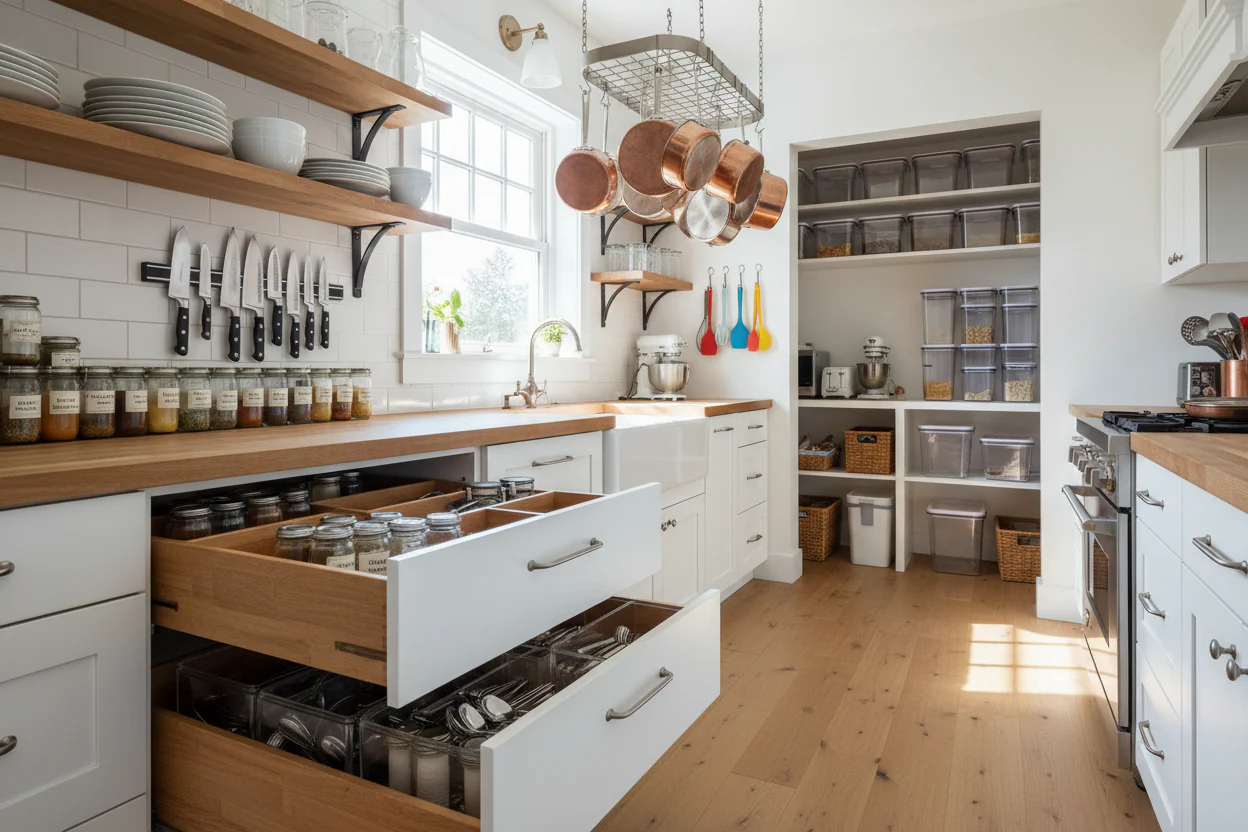
Drawer organizers help most when they fit the objects, not the other way around. Expandable bamboo trays work well for flatware. Narrow bins help with straws, bag clips, and thermometers. Deep drawer peg systems can hold plates, bowls, or pots if your kitchen has wide lower drawers.
A Tampa renter with limited cabinets may turn one deep drawer into a full dinnerware station. Plates, bowls, cloth napkins, and placemats can sit together near the table area. That move frees upper cabinets for food and makes setting the table faster. Not fancy. Useful.
Make Food Storage Clear, Visible, and Easy to Maintain
Food storage fails when it depends on memory. You cannot cook what you cannot see, and you cannot manage what gets buried behind half-used bags. A clean kitchen needs food systems that show you what is available before you buy more.
Pantry organization that prevents duplicate groceries
Pantry organization is less about perfect labels and more about honest visibility. If three boxes of pasta are hiding in different places, your grocery list will betray you. Zones keep that from happening.
Create sections based on meals, not store categories. Breakfast foods can sit together. Baking goods can share a shelf. Quick dinner bases like rice, pasta, canned beans, and sauces can live in one area. Snacks deserve their own space, especially in homes with kids who treat pantry doors like revolving doors.
Clear containers can help, but only when they match your habits. Decanting every cracker and cereal into jars may look clean for two weeks, then collapse if no one wants to keep doing it. Use containers for items that spill, go stale, or need quick measuring. Leave the rest in packaging if that keeps the system alive.
A smart pantry has a “use first” zone. Place opened items, near-expiration foods, and leftovers from recipes in one visible bin. That one bin can cut waste without a spreadsheet, a meal planning app, or a lecture taped to the fridge.
Labeling only works when the whole household understands it
Labels can make pantry organization easier, but bad labels create quiet confusion. A bin marked “miscellaneous” is a junk drawer with better handwriting. A shelf marked “dinner helpers” may mean something to you and nothing to everyone else.
Good labels name real behavior. “School snacks,” “baking,” “rice and pasta,” “coffee and tea,” and “lunch packing” are easy to understand. They do not require a tour. They guide people back to the right place after they use something.
This matters in busy American households where kitchens serve many roles. A parent packs lunch, a teenager makes noodles, a guest searches for coffee, and someone unloads groceries after work. The system has to survive more than one person’s brain.
The quiet surprise is that labels are not for finding things first. They are for putting things back. Finding is the easy part. Returning items to the same home is what keeps the space clean after the first weekend.
Protect Counter Space Like It Is the Kitchen’s Breathing Room
Counters carry the emotional weight of a kitchen. When they are clear, the room feels calmer even if a cabinet still needs work. When they are crowded, the whole kitchen feels behind before you cook a single thing.
Keep appliances out only when they earn daily space
Appliances love to colonize counters. Coffee makers, air fryers, toasters, stand mixers, blenders, and knife blocks can fill every open inch. Some deserve the space. Many do not.
A practical rule works well: if you use it daily, it can stay out. If you use it weekly, it needs a nearby cabinet or shelf. If you use it monthly, it should not live where chopping vegetables should happen. This rule feels strict until you experience a counter that is ready before you start.
Small kitchen organization depends heavily on this choice. In a studio apartment in Los Angeles or a compact condo in Boston, one appliance too many can turn cooking into a balancing act. A toaster stored in a lower cabinet may feel inconvenient at first, but a free prep surface pays you back every meal.
One exception deserves respect. If storing an appliance makes you stop using it, keep it where life happens. A blender for daily smoothies or a coffee maker for every morning has earned its place. Storage should support real habits, not punish them.
Use walls, doors, and vertical space without crowding the room
Vertical storage can rescue a tight kitchen, but it can also make the room feel busy. The difference comes down to editing. Walls should hold items that are useful, attractive enough to see, or too awkward for drawers.
A magnetic knife strip can free a counter from a bulky knife block. A rail with hooks can hold measuring cups, mugs, or small pans. Inside cabinet doors can store lids, wraps, cutting boards, or cleaning supplies if the door still closes without a fight.
Open shelving needs more discipline than closed cabinets. It works best for matching dishes, glass jars, cookbooks, or daily mugs. It does not work well for every plastic cup your household has collected since 2014. Be honest about what you want to see every morning.
There is a small design lesson hidden here: vertical storage should create relief, not visual noise. If a wall system makes your kitchen feel like a hardware aisle, it has gone too far. Cleaner cooking spaces need breathing room for the eyes too.
Keep the System Clean After the First Big Reset
The first cleanup feels satisfying, but the real test comes two weeks later. Storage only succeeds when it can handle groceries, tired evenings, rushed breakfasts, and the ordinary mess of living. A good system bends without breaking.
Build reset habits into moments you already have
A kitchen reset should not require a free Saturday. It should attach itself to things you already do. After dinner, return pans to their spots. Before trash day, scan the fridge. Before grocery shopping, check the pantry’s use-first bin.
Small resets work because they remove drama. Five minutes after dinner can prevent an hour of weekend cleanup. That trade matters when a kitchen supports family meals, remote work coffee breaks, school snacks, and late-night leftovers.
Drawer organizers make resets easier because they reduce decision fatigue. A tool either belongs in the slot or it does not. That small boundary saves energy, especially when you are tired and tempted to toss everything into the nearest drawer.
A good habit feels almost boring. That is the point. The best storage system does not demand attention every day. It quietly catches the mess before it spreads.
Let your kitchen change when your life changes
A kitchen that worked last year may not work now. A new baby, a different job schedule, a teenager learning to cook, or a shift toward meal prep can all change what needs prime space. Storage should move when life moves.
Review your setup every season. You do not need a full overhaul. Check what keeps landing on the counter, what items never return to their homes, and what cabinet feels irritating. Those friction points tell you where the system is failing.
A family in Phoenix may store water bottles and lunch containers front and center during school months, then shift grilling tools and picnic supplies forward in summer. A New York apartment cook may keep soup pots easy to reach in winter and move salad tools forward when warmer weather changes meals.
Smart kitchen storage tips are not about chasing a perfect pantry photo. They are about building a kitchen that respects your time, your space, and the way you actually cook. Start with one drawer, one shelf, or one counter zone today, then let each small fix make the next meal easier.
Frequently Asked Questions
What are the best ways to organize a small kitchen?
Start by removing anything you do not use weekly from prime space. Keep daily tools near their task zones, use vertical storage carefully, and group food by meal type. Small kitchens work better when every item earns its location.
How can I make my kitchen counters look cleaner?
Keep only daily-use appliances on the counter and move occasional tools into cabinets, shelves, or pantry areas. Use trays for small items like oil and salt so they look intentional instead of scattered. Clear prep space changes the whole room.
What should I store in deep kitchen cabinets?
Deep cabinets work best for grouped items inside pull-out shelves, handled bins, or large baskets. Store pots, small appliances, baking supplies, or bulk goods there, but avoid loose mixed items. Visibility matters more than filling every inch.
How do drawer organizers help in a kitchen?
They give each tool a fixed home, which makes cleanup faster and prevents drawers from turning into clutter traps. Use them for flatware, cooking utensils, food storage lids, bag clips, and baking tools. The right divider saves time every day.
What is the easiest way to organize pantry shelves?
Group foods by how you use them, such as breakfast, baking, snacks, dinner bases, and lunch packing. Keep opened or soon-to-expire items in a visible use-first bin. This method reduces duplicate buying and helps food get used.
Should I use clear containers in my pantry?
Use clear containers for foods that spill, go stale, or need easy measuring, such as flour, rice, pasta, cereal, and snacks. Do not force every item into a container if your household will not maintain it. Simple systems last longer.
How often should I reorganize my kitchen storage?
Review problem areas every season or whenever your routine changes. You do not need to redo the whole kitchen. Focus on the drawer, shelf, or counter zone that keeps causing frustration, then adjust it around your current habits.
How do I keep my kitchen organized after cleaning it?
Attach small resets to daily routines. Put tools away after dinner, check the pantry before shopping, and clear counters before bed. Storage stays clean when the system is easy enough to follow while tired, rushed, or distracted.